Representation of Gender Dracula 1958 and Kiss of the Vampire 1963

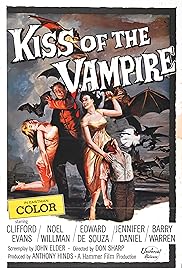
Compare the representation of gender in the posters for ‘Dracula’ 1958 and ‘Kiss of the Vampire’ 1963.
A comparison of the representation of gender in the ‘Dracula’ film poster (1958) and ‘Kiss of the Vampire’ film poster (1963). Both films are of the Horror genre.
Both posters are produced for an audience of the 1960s. During the 1960s it was an era of social change a period where Women’s rights were becoming a topic matter of society. Increasingly dominate male representation was slowly becoming less relatable to an audience. This caused some media texts to conform to the growing trend in social ideology, which gained gratification from some audiences. Although there was a backlash from other media producers; they continued to portray female characters as the submissive ‘victim’.
In ‘Kiss of the Vampire’ we can identify, with Propp’s theory, a likely; antagonist, co-antagonist and victim. It could be said that encoded within the text, the strong female (positioned centre frame) connotes the sexual liberation of woman in the 1960s. The audience can identify the female antagonist from the central positioning in the text.
The body composition with the female antagonist is an; open, violent posture, allowing the audience to connote her significance, perhaps as ‘Vampire’ in the film. Her costume drapes off her shoulders in a, well fitted, draped light coloured dress. This positioned the female under the male gaze, to appeal to a male audience. Colour and lighting have been composed by the producer to remove the idea of innocence and to further deepen the sense of enigma to the romance connoted from ‘Kiss’ in the film title, furthermore, this would add theatrical semiotics considers by Barthes.
On the other hand, the female in the left third of the frame is draped over the male's arm. She appears to be lifeless as a victim or alternatively needing a male to rescue her. Either way, it conforms to the submissive ideology. Equally, she is objectified, connoting the social oppression of woman in the 1960s, a binary opposition to the antagonist is seen centre frame.
In the right third of the frame with have the male victim positioned under the female antagonist. This refutes Neale’s genre theory of typically having female victims. The body composition of the male victim is also very open, with his throat exposed close to a dagger and this could foreshadow his death and connote a sense of innocence. It’s important to also recognize the final male character is also a binary opposite to this portal. These gender oppositions could connote an alternative reading for the audience with Gauntlett’s theory of identity suggesting they could find identity and gratification in the power struggles of the dominance of genders in the 1960s.
With the comparative text ‘Dracula’ we also see a dominant male figure. This time the male character is centre frame connoting him as Propp’s Protagonist. The colours are dark, which is a convention of the horror genre. The lighting allows the audience to identify his defined cheekbones, in addition to his direct address to the audience which allows the character to intimidate the audience, which connotes the stereotypical dominant role of males.
With ‘Dracula’ the audience also sees a negative representation of females. The character is beneath the dominant male and much smaller in size, connoting her weakness and vulnerability. Additionally, the audience sees her positioned for the male gaze, with little costume to show, sexually objectifying woman- conventional of media texts at the time.
With both texts, the female gender is typically represented negatively. However in the poster of ‘Kiss of the Vampire’, it shows a contrast in representing both genders positively and negatively contributing to the social change within the 1960s. Therefore we can say that gender is represented differently in both texts, with some intertextual similarities.
[18/20 Marks]


Comments
Post a Comment